Tungsten Alloy Balancing Ball
1. What's Tungsten Alloy Balancing Ball?
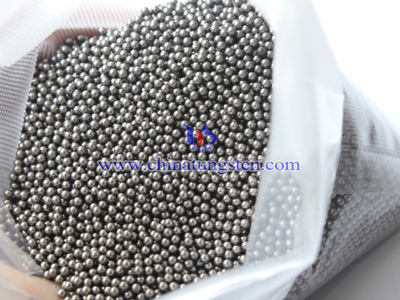
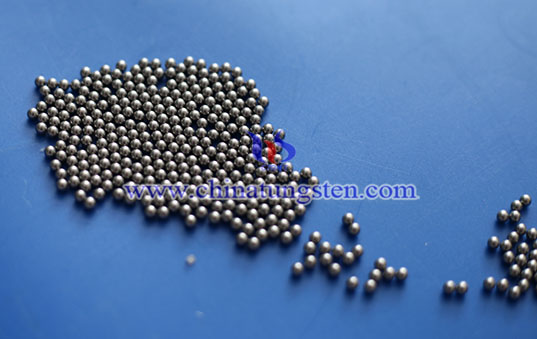
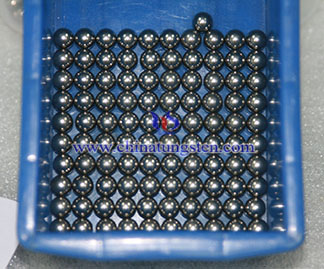
Tungsten alloy balancing ball, also known as tungsten alloy ball counterweight, is a spherical balance element made from high-specific-gravity tungsten alloy. It mainly achieves static balance, dynamic balance and motion stability of rotating components by concentrating mass, adjusting mass distribution or changing moment of inertia. Common material systems include W-Ni-Fe and W-Ni-Cu alloys, which can be selected according to the magnetic requirements and structural space of the equipment.
2. Features of CTIA's Tungsten Alloy Balancing Ball
(1) High Density and Small Volume: Density is typically 16.5–18.75 g/cm³, about 2–2.5 times that of steel and 1.5–1.7 times that of lead. Under the same mass the volume is significantly smaller, suitable for precision counterweighting in space-constrained environments.
(2) Excellent Mechanical Properties: Tensile strength often reaches 700–1500 MPa with high hardness, wear resistance and impact resistance. High elastic modulus results in small deformation under load, enabling it to withstand centrifugal force and vibration loads.
(3) Good High-Temperature Resistance and Thermal Stability: High melting point allows mechanical properties to be maintained at elevated temperatures. Low coefficient of thermal expansion (approximately 1/2–1/3 that of iron/steel) provides strong dimensional stability.
(4) Environmentally Friendly and Non-Toxic: Non-toxic and non-radioactive, serving as an ideal alternative to lead and depleted uranium, and complying with environmental standards.
(5) Corrosion Resistance and Machinability: Resistant to acid, alkali and humid environments with low susceptibility to rust. Can be precision turned, ground and polished with high dimensional accuracy, and customized in different diameters and compositions.
(6) Other Characteristics: Some grades are non-magnetic or weakly magnetic, reducing electromagnetic interference. Good thermal conductivity, long service life and strong shape retention capability.
3. Types of CTIA's Tungsten Alloy Balancing Ball
(1) W-Ni-Fe Tungsten Alloy Balancing Ball: Magnetic, suitable for balance structures without special restrictions on material magnetism.
(2) W-Ni-Cu Tungsten Alloy Balancing Ball: Non-magnetic, suitable for equipment and precision motion components with requirements for magnetic environments.
4. Applications of CTIA's Tungsten Alloy Balancing Ball
(1) Automotive and Racing: Applied in wheel balancing and mass compensation of certain rotating components to improve rotational balance by adding or adjusting local mass.
(2) Aerospace: Applied in flight control mechanisms, gyroscopes and rotating components for mass configuration and inertia adjustment, suitable for structures with strict weight and space requirements.
(3) Mechanical Watches: Applied in automatic mechanical watch rotors, oscillating weights and other motion components to influence moment of inertia through mass configuration, meeting motion regulation needs under compact structures.
(4) Consumer Electronics: Applied in miniature vibration mechanisms of mobile phones, game controllers and similar devices to produce required vibration effects by adjusting eccentric mass.
(5) Precision Instruments: Applied in certain precision motion mechanisms requiring mass regulation or inertia configuration to improve the balance state of motion components by adding or adjusting local mass.
5. Specifications of CTIA's Tungsten Alloy Balancing Ball
(1) Materials: W-Ni-Fe, W-Ni-Cu
(2) Tungsten Content: 90–97%
(3) Density: 16.5–18.8 g/cm³
(4) Ball Diameter: 1–100 mm, customizable
(5) Sphericity Tolerance: ≤0.002 mm, depending on ball diameter and required precision.
(6) Surface Roughness: Customizable
CTIA GROUP has nearly 30 years of experience in tungsten alloy manufacturing, with capabilities covering powder metallurgy, liquid-phase sintering, and precision machining. CTIA provides customized manufacturing solutions based on the material system, ball diameter, individual ball weight, sphericity, and structural requirements of the balancing balls. CTIA controls material composition, dimensional accuracy, weight, and sphericity throughout manufacturing to maintain batch consistency and meet the requirements of rotating components for mass distribution, balance accuracy, and motion stability.
For any inquiry, please contact tungsten alloy manufacturer: CTIA GROUP
Email: sales@chinatungsten.com
Tel: 0086 592 5129696 / 0086 592 5129595
Website: tungsten-alloy.com
WeChat:

Related Products: