Tungsten Alloy Flywheel Counterweight
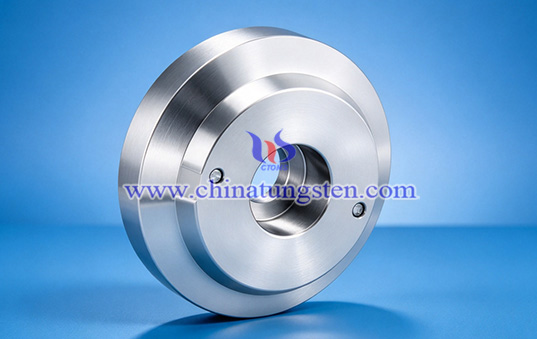
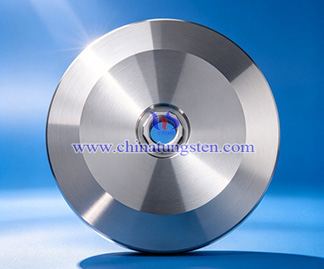
1. What's Tungsten Alloy Flywheel Counterweight?
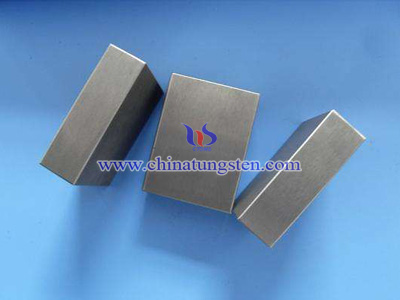
Tungsten alloy flywheel counterweight is mass-balancing component made from tungsten alloy containing 90%–97% tungsten, with nickel, iron, or copper as binder phases, and produced through powder metallurgy liquid-phase sintering. CTIA's tungsten alloy flywheel counterweight adjusts localized flywheel mass to modify mass distribution and moment of inertia for dynamic balancing and rotational stability control.
2. Features of CTIA's Tungsten Alloy Flywheel Counterweight
(1) High Density and Compact Size: Tungsten alloy typically has a density of 16.5–18.8 g/cm³, allowing greater mass to be configured within the same volume and making it suitable for inertial mass placement in limited flywheel space.
(2) Adjustable Mass Distribution: Adjusting counterweight mass, quantity, and mounting position can modify flywheel mass distribution and moment of inertia to meet dynamic balancing requirements.
(3) High Strength for Rotational Loads: Tungsten alloy offers relatively high strength and hardness, allowing the counterweight to withstand centrifugal forces and periodic mechanical loads generated during flywheel rotation.
(4) Dimensional Stability: Tungsten alloy has a relatively low coefficient of thermal expansion, resulting in small dimensional changes with temperature variations and helping maintain stable mass distribution during long-term flywheel operation.
3. Applications of CTIA's Tungsten Alloy Flywheel Counterweight
(1) Automotive Engines and Drivetrain Systems: Used in automotive flywheels and dual-mass flywheels for mass adjustment and dynamic balancing, with moment of inertia adjusted to support rotational stability and reduce vibration and noise.
(2) Industrial Flywheel Energy Storage Systems: Used for inertia configuration and dynamic balancing of high-speed flywheel rotors, allowing inertial mass to be concentrated within limited installation space.
(3) Aerospace Flywheels: Used in satellite momentum wheels and reaction wheels for mass balancing and inertia configuration, with mass distribution and moment of inertia adjusted to support spacecraft attitude control.
(4) New Energy and Power Systems: Used in hybrid power systems and other power systems that employ flywheels for energy recovery and release, with flywheel mass distribution and moment of inertia adjusted according to operating requirements.
(5) Precision Machinery and Test Equipment: Used in high-speed rotary test benches, precision transmission mechanisms, and other flywheel rotors for dynamic balancing and rotational stability control through localized mass compensation.
4. Specifications of CTIA's Tungsten Alloy Flywheel Counterweight
(1) Materials: W-Ni-Fe, W-Ni-Cu
(2) Tungsten Content: 90%–97%
(3) Density: 16.5–18.8 g/cm³
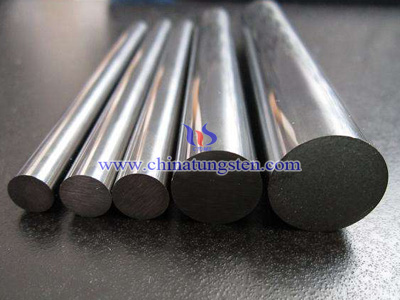
(4) Shapes: Rings, discs, cylinders, sector-shaped parts, and customized components
(5) Dimensions: Customizable
(6) Surface Condition: Precision-ground, polished, customizable
With nearly 30 years of experience in tungsten alloy manufacturing, CTIA GROUP (CTIA) has established capabilities in powder metallurgy and precision machining. CTIA provides customized tungsten alloy flywheel counterweights with tungsten content, material system, structural form, dimensions, and machining tolerances matched to specific application requirements in automotive power systems, aerospace, and industrial rotating machinery.
For any inquiry, please contact tungsten alloy manufacturer: CTIA GROUP
Email: sales@chinatungsten.com
Tel: 0086 592 5129696 / 0086 592 5129595
Website: tungsten-alloy.com
WeChat:

Related Products: