Tungsten Alloy Plate Counterweight
1. What's Tungsten Alloy Plate Counterweight?
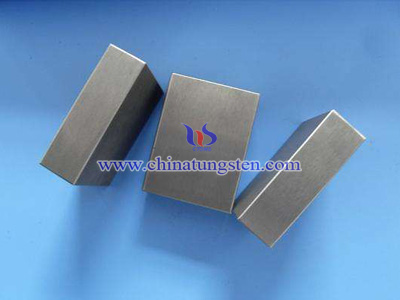
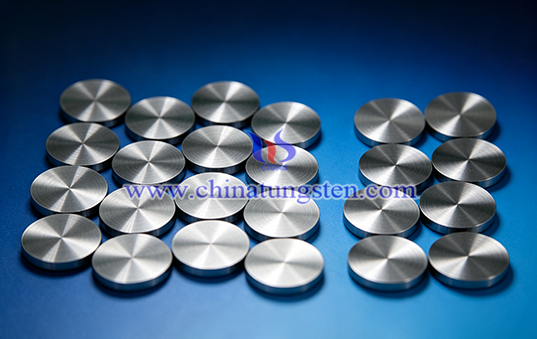
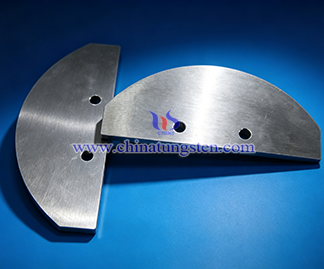
Tungsten alloy plate counterweight is plate-shaped counterweight component made from tungsten-based heavy alloy with nickel, iron, or copper as binder-phase elements. Manufactured through powder metallurgy, it is used to adjust local mass within limited spaces for equipment balancing, dynamic balance, and center-of-gravity adjustment. CTIA manufactures sheets, plates, discs, and irregular plates, with holes, slots, threads, and other structural features machined to suit different installation methods.
2. Features of CTIA's Tungsten Alloy Plate Counterweight
(1) High Density for More Compact Counterweighting: Density is approximately 16.5–18.8 g/cm³. Under the same weight the volume is significantly smaller than that of steel and lead, suitable for space-constrained installation positions.
(2) Plate Structure Facilitates Layout: Thickness, length, width and profile can be designed according to the installation position. Mass can be adjusted by surface mounting, embedding or stacking methods.
(3) Capability to Withstand Dynamic Loads: Tensile strength is approximately 700–1200 MPa, enabling adaptation to centrifugal loads generated by vibration, impact and rotation.
(4) Small Dimensional Variation: Coefficient of thermal expansion is approximately 4.5–6.0×10⁻⁶/°C, providing good dimensional stability under temperature changes.
(5) Controllable Machining and Precision: Supports multiple machining methods including turning, milling, grinding, drilling and tapping to meet different structural and assembly precision requirements.
3. Applications of CTIA's Tungsten Alloy Plate Counterweight
(1) Aerospace and Precision Instruments: Used in aircraft motion components, gyroscopes, inertial assemblies and optical platforms.
(2) Automotive and Racing: Used in hubs, chassis, steering systems, engines and flywheels.
(3) Machinery and Rotating Systems: Used in spindles, rotors, pumps, fans and compressors.
(4) Industrial Equipment: Used in robotic arms, motors, industrial robots and automation equipment.
(5) Medical Equipment: Used in CT equipment, PET equipment, MRI equipment, radiotherapy equipment and medical robots.
(6) Drones and Models: Used in airframes, wings, gimbals, power components and model structures.
(7) Sports Equipment: Used in golf club heads, tennis rackets and fishing gear.
(8) Consumer Electronics: Used in mobile phones, vibration motors, wearable devices, camera modules and game controllers.
(9) Ships and Ocean Engineering: Used in ships, submarines, underwater equipment and marine equipment.
4. Specifications of CTIA's Tungsten Alloy Plate Counterweight
(1) Materials: W-Ni-Fe, W-Ni-Cu
(2) Tungsten Content: 90%–97%
(3) Density: 16.5–18.8 g/cm³
(4) Shapes: Sheet, plate, disc, irregular plate
(5) Dimensions: Customizable
With nearly 30 years of experience in tungsten alloy manufacturing, CTIA GROUP has established an integrated manufacturing process covering alloy material preparation, powder metallurgy forming, liquid-phase sintering, and precision machining. CTIA provides material and structural design for tungsten alloy counterweights based on requirements for density, weight, dimensions, installation, and application. CTIA provides customized solutions for different equipment structures and installation conditions.
For any inquiry, please contact tungsten alloy manufacturer: CTIA GROUP
Email: sales@chinatungsten.com
Tel: 0086 592 5129696 / 0086 592 5129595
Website: tungsten-alloy.com
WeChat:

Related Products: