Tungsten Alloy Counterweight vs. Lead Counterweight
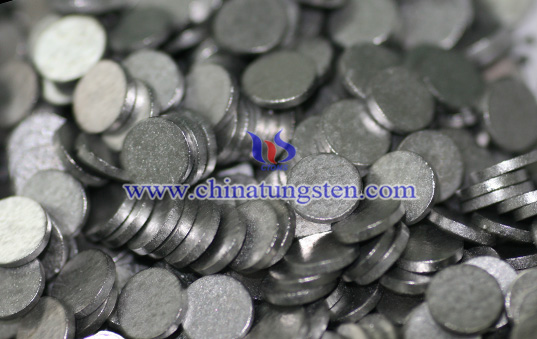
Tungsten alloy counterweight and lead counterweight both provide mass compensation for equipment, but differ in density, mechanical properties, cost, and material safety. Tungsten alloy offers higher density, allowing a smaller counterweight volume at the same mass, while lead is generally less expensive and easier to form. These differences influence material selection, structural design, and machining requirements across different applications. The following comparison covers material properties, performance, machining processes, and customization options to help determine which material is better suited to different counterweight applications.
1. What Are Differences Between Tungsten Alloy Counterweights and Lead Counterweights?
CTIA's tungsten alloy counterweights typically use tungsten-nickel-iron (W-Ni-Fe) or tungsten-nickel-copper (W-Ni-Cu) alloys produced by powder metallurgy. Lead counterweights primarily consist of metallic lead. Both materials can increase equipment mass, adjust the center of gravity, and improve balance, but they differ in density, mechanical properties, machining methods, and material safety management.
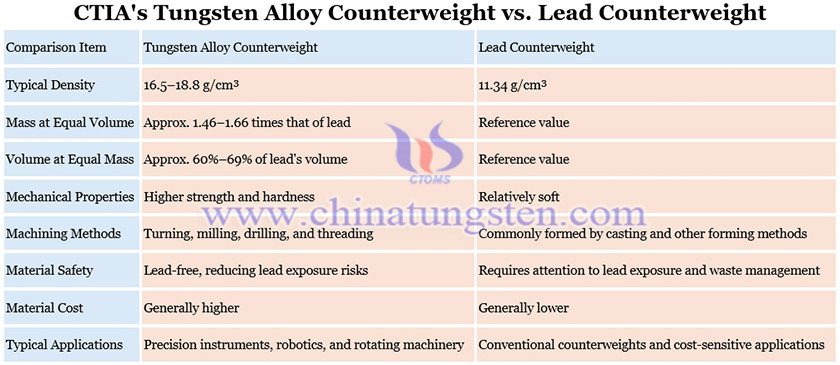
The key differences between CTIA's tungsten alloy counterweights and lead counterweights are shown in the following picture:
2. What Are Advantages of Tungsten Alloy Counterweights over Lead Counterweights?
(1) Higher Density for Compact Counterweight Design
Tungsten alloy counterweights typically have a density of 16.5–18.8 g/cm³, significantly higher than lead's approximately 11.34 g/cm³. At equal mass, tungsten alloy counterweight occupies approximately 60%–69% of the volume of lead counterweight. This makes tungsten alloy suitable for precision instruments, robotic joints, and rotating machinery where installation space is limited and mass must be concentrated.
(2) Greater Strength for Precision Mounting
Tungsten alloy offers relatively high strength and hardness, making it suitable for counterweights with mounting holes, threads, steps, and locating surfaces. These features can meet equipment requirements for dimensional accuracy, connection methods, and mechanical fastening. Actual load-bearing capacity depends on the alloy grade, component design, and operating conditions.
(3) Lead-Free Material for Easier Safety Management
Tungsten alloy contains no lead, helping reduce lead exposure risks and related waste-management concerns. Tungsten alloy counterweights can serve as an alternative to lead counterweights in equipment subject to environmental material requirements. Compliance with regulations such as RoHS and REACH must still be verified according to the specific composition, product category, and applicable requirements.
(4) Flexible Shapes for Different Equipment Structures
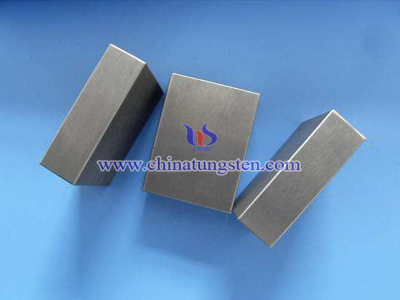
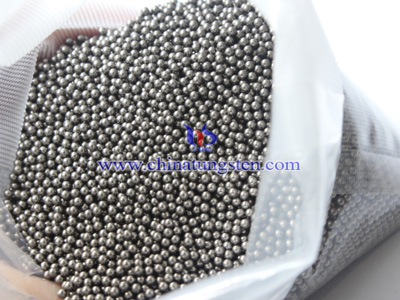
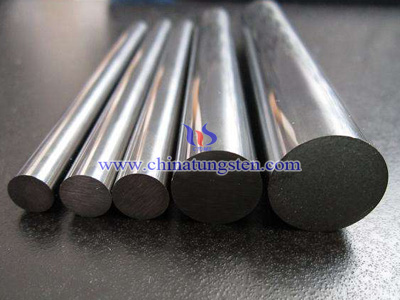
Tungsten alloy can be machined into blocks, rods, balls, plates, and irregularly shaped counterweights. Product design can account for target mass, center-of-gravity position, installation space, and mounting method. Rotating equipment may also require consideration of mass distribution and dynamic balancing requirements.
3. How to Choose Tungsten Alloy Counterweights?
Tungsten alloy counterweights are suitable for equipment with limited installation space, high mass-density requirements, or precision machining needs. Lead counterweights may suit applications with sufficient space, simple structures, and a strong focus on material cost. CTIA recommends confirming the following parameters during material selection.
(1) Target Mass and Available Space: Determine the required counterweight mass and available installation space.
(2) Dimensional Accuracy and Mounting Requirements: Specify component dimensions, machining tolerances, and fastening methods.
(3) Operating and Magnetic Conditions: Confirm operating speed, mechanical loads, and magnetic requirements.
(4) Cost and Regulatory Compliance: Evaluate material prices, machining costs, and applicable regulations.
When replacing lead counterweight with tungsten alloy counterweight, recalculate the component volume, mass distribution, center-of-gravity position, and installation dimensions.
CTIA GROUP (CTIA) has nearly 30 years of experience in tungsten alloy manufacturing, with capabilities in material selection, counterweight structural design, precision machining, and quality inspection. CTIA offers customized tungsten alloy counterweight solutions for different target masses, installation spaces, dimensional accuracy requirements, and operating conditions. CTIA provides W-Ni-Fe and W-Ni-Cu materials in various density grades, with customizable dimensions and mounting structures for mechanical equipment, precision instruments, and rotating systems.
For any inquiry, please contact tungsten alloy manufacturer: CTIA GROUP
Email: sales@chinatungsten.com
Tel: 0086 592 5129696 / 0086 592 5129595
Website: tungsten-alloy.com
WeChat:

Related Products: