Tungsten Alloy Crankshaft Counterweight
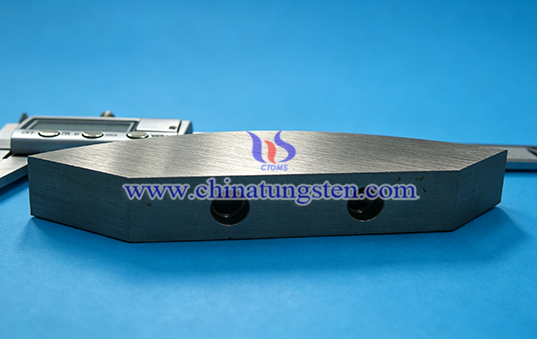
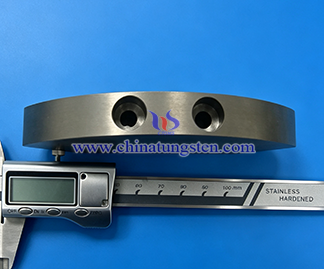
1. What's Tungsten Alloy Crankshaft Counterweight?
Tungsten alloy crankshaft counterweight is high-density mass-balancing component installed on engine crankshaft, mainly for automotive, racing, and high-performance engines. CTIA's tungsten alloy crankshaft counterweight takes advantage of high density and compact size of tungsten alloy to place greater counterweight mass within limited crankshaft space. By adjusting mass distribution at designated crankshaft positions, it helps balance inertial forces generated by the crank-slider mechanism, reduce rotational imbalance and vibration, and meet applications with demanding requirements for counterweight dimensions and crankshaft dynamic balancing.
2. Why Do Crankshafts Use Tungsten Alloy Counterweights?
(1) Increase Counterweight Mass and Reduce Installation Volume: Tungsten alloy has a density of approximately 16.5–18.8 g/cm³, requiring less volume for the same mass and allowing greater counterweight mass to be positioned within limited crankshaft space.
(2) Concentrate Counterweight Mass and Improve Dynamic Balance: High-density tungsten alloy allows greater mass to be concentrated at designated crankshaft positions. By properly configuring counterweight mass and location, crankshaft mass distribution can be adjusted to reduce rotational imbalance and vibration.
(3) Withstand Rotational Loads and Maintain Structural Stability: Tungsten alloy offers good strength, hardness, and wear resistance, with a coefficient of thermal expansion of approximately 4–6×10⁻⁶/°C, meeting the operating requirements of crankshaft counterweights under high-speed rotation and cyclic loads.
3. Applications of CTIA's Tungsten Alloy Crankshaft Counterweight
(1) Racing Engines: Used for crankshaft counterweighting in high-speed racing engines, particularly where crankshaft space is limited but greater counterweight mass is required.
(2) High-Performance Automotive Engines: Used for crankshaft counterweighting in high-speed, high-power-density engines, providing the required counterweight mass within compact crankshaft structures.
(3) Modified and Competition Engines: Used for crankshaft modifications, performance upgrades, and competition engines, with counterweight mass, dimensions, and mounting positions configured according to revised balancing requirements.
(4) High-Performance Motorcycle Engines: Used for crankshafts in high-speed, compact motorcycle engines, particularly where counterweight space and crankshaft balancing requirements are demanding.
(5) Special-Purpose Custom Engines: Used for engines with special crankshaft structures or counterweight requirements, with the counterweight customized according to crankshaft structure, installation space, and target balancing parameters.
4. Specifications of CTIA's Tungsten Alloy Crankshaft Counterweight
(1) Materials: W-Ni-Fe, W-Ni-Cu
(2) Tungsten Content: 90%–97%
(3) Density: 16.5–18.8 g/cm³
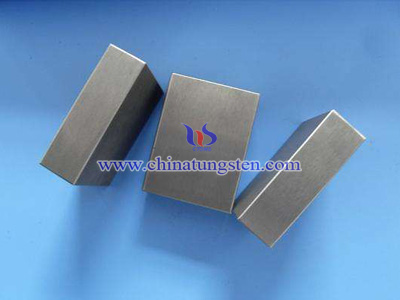
(4) Shapes: Arcuate, fan-shaped, block-shaped, and customized structures
(5) Dimensions: Customizable
CTIA GROUP (CTIA) has nearly 30 years of experience in tungsten alloy manufacturing, with integrated capabilities in powder metallurgy and precision machining. CTIA provides tungsten alloy crankshaft counterweights tailored to crankshaft structure, target counterweight mass, and installation space, with suitable material grades, complex geometries, dimensions, and fitting tolerances customized to achieve precise mass configuration and meet the balancing requirements of different crankshaft designs.
For any inquiry, please contact tungsten alloy manufacturer: CTIA GROUP
Email: sales@chinatungsten.com
Tel: 0086 592 5129696 / 0086 592 5129595
Website: tungsten-alloy.com
WeChat:

Related Products: